 Featured on
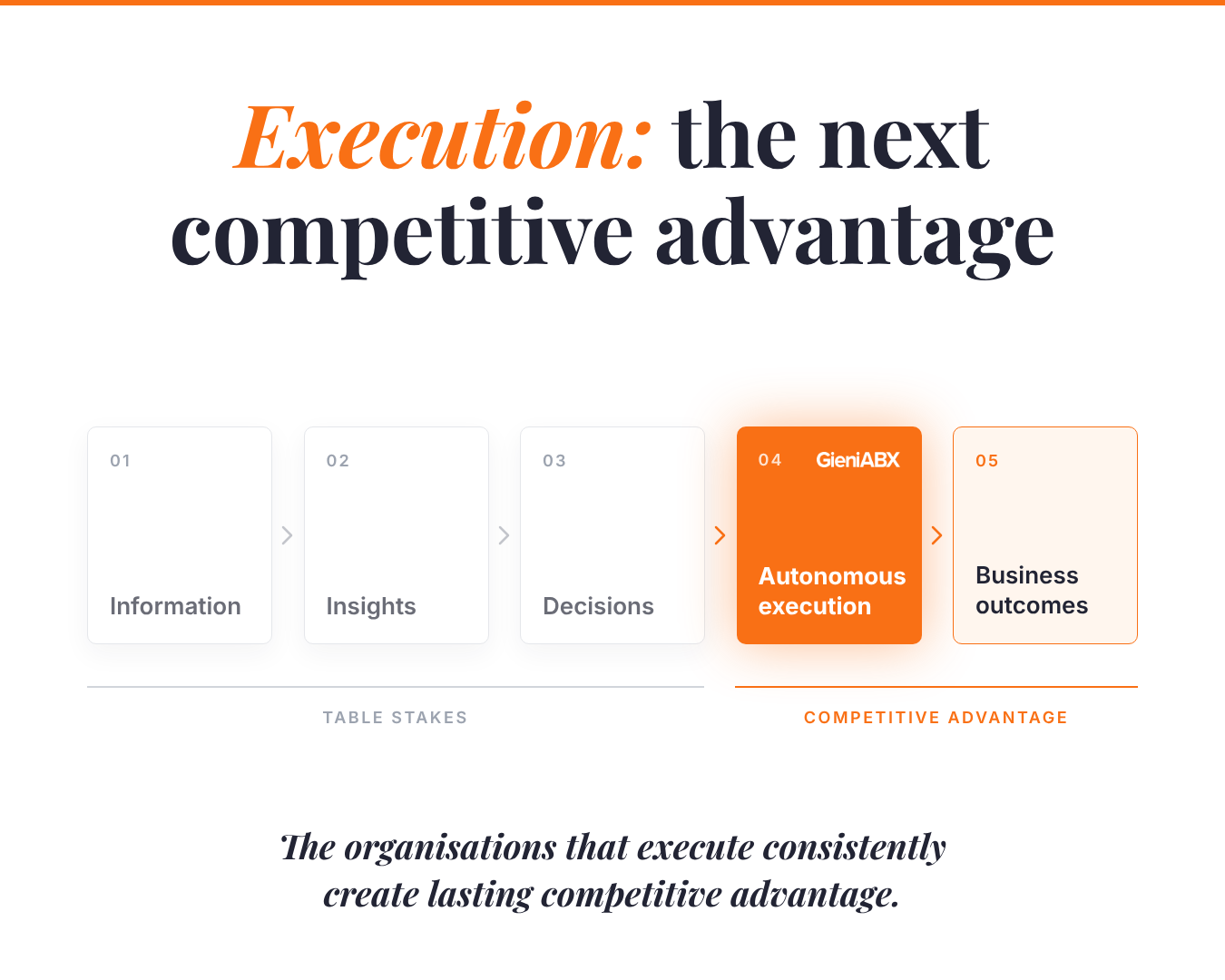
For a long time, businesses competed on how well informed they were.
Companies that gathered more data, produced sharper insights and reached decisions faster tended to pull ahead. Enterprise software grew up around that goal: dashboards opened visibility into every department, analytics surfaced trends that used to stay hidden and artificial intelligence compressed hours of information processing into seconds.
Those capabilities are now becoming table stakes.
Most organisations already sit on more information than they can realistically act on. AI assistants summarise meetings, draft customer emails and analyse reports in moments. Managers track outstanding approvals, project progress and sales performance in real time. Working out what should happen next has become far easier than it was even a few years ago.
The real challenge has moved.
Business performance no longer hinges on decision quality alone. Decisions still have to travel through the organisation before they produce value: opportunities must advance through the pipeline, customer requests need action, approvals gate whether work proceeds and information has to pass reliably between systems and teams. Every organisation depends on these processes executing consistently, and in many of them, that still runs on manual coordination.
Growth compounds the problem. More customers, employees and systems naturally push up operational complexity. Customer demand generates more work, larger teams mean more handovers, and connected systems improve visibility while multiplying the processes that have to stay aligned. Keeping work moving consistently ends up demanding ever more coordination.
The standard answer, for years, has been more people. Sales support teams grow, project coordinators get hired and administrative duties spread across the organisation just to keep things moving. It worked because no practical alternative existed for executing routine business processes at scale.
ABX changes that equation.
Autonomous Business Execution executes approved business processes according to business rules the organisation has defined, removing the need for people to push work from stage to stage by hand. After decisions are made, workflows carry on consistently across people, departments and systems, while employees keep responsibility for the judgement, experience and context that technology cannot replace.
The payoff goes well beyond efficiency.
Operations become more consistent, the operational overhead that normally comes with growth shrinks and the organisation can handle more work without constantly expanding manual coordination. Employees put more of their time into strengthening customer relationships, cracking complex business problems and making informed decisions, because routine execution stops competing for their attention.
This is exactly why execution is turning into a competitive advantage.
As artificial intelligence spreads, access to information will differentiate less and less. Productivity gains will be assumed, not admired. What will set organisations apart is how quickly, consistently and at what scale they convert decisions into completed work.
Businesses that execute reliably will respond faster, serve customers more consistently and scale more effectively than those where operational work still leans on manual coordination. Lasting advantage will belong to the organisations that make sure good decisions get carried through, every single time.
As enterprise AI keeps evolving, organisations will combine specialised technologies that each carry a distinct responsibility. AI assistants lift productivity, Agentic AI supports planning and reasoning, and Autonomous Business Execution keeps approved business processes running consistently across the organisation. The combination produces businesses that are better informed and, crucially, better equipped to execute.