 Featured on
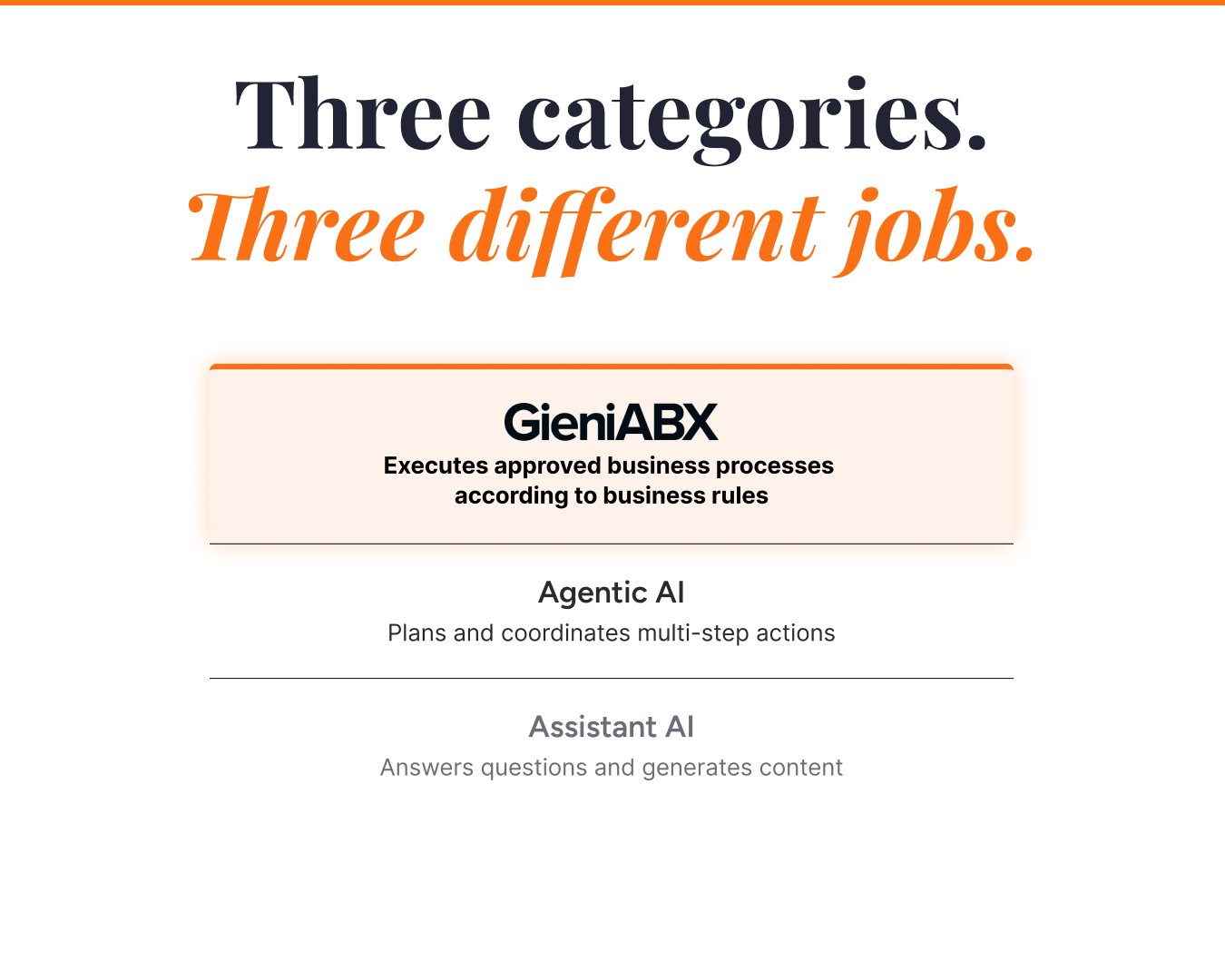
The enterprise software landscape now includes a growing number of AI categories. Assistant AI, Agentic AI and Autonomous Business Execution increasingly come up in the same conversations, even though they are frequently treated as if they were interchangeable.
Each of these categories was built to address a distinct business problem, and recognising those differences matters more and more as organisations work out where AI belongs in their operations.
For enterprise leaders assessing autonomous AI options, the key decision isn't which technology is more advanced, but which category matches the outcome they actually need.
Why the lines between these categories blur
AI is already embedded in how many organisations operate day to day. Employees use it to draft emails, analyse reports, summarise meetings and generate content, all without leaving the tools they already work in.
As these capabilities have grown, so has the number of AI categories businesses can choose from. Assistant AI, Agentic AI and Autonomous Business Execution are all built on artificial intelligence, yet each plays a different role inside the organisation.
A sound AI strategy starts with understanding exactly what responsibility each category was built to carry.
The role Agentic AI plays
Agentic AI is built for moments when the route to an outcome hasn't yet been mapped out. It reviews information, weighs up different options, breaks larger objectives into smaller tasks and adjusts its approach as new information comes in. This makes it especially useful for research, planning and decision-making, situations where no fixed sequence of steps already exists.
Picture a procurement team weighing up suppliers for a large manufacturing project. An Agentic AI system can evaluate proposals, flag potential risks, suggest suppliers against defined criteria and explain the reasoning behind each recommendation, arming the team with the context to make an informed choice.
Its job is to sharpen decision-making before any work actually begins.
The role Autonomous Business Execution plays
Autonomous Business Execution picks up once those decisions have already been made.
Even after an organisation has set its operating rules, approvals and workflows, the work itself still has to move consistently between people, systems and departments.
Take a customer asking for a product demo. From there, the opportunity moves through the organisation following an approved process: it's logged in Salesforce, ownership goes to the right account executive, follow-up tasks are generated and the relevant teams get the information they need to keep the workflow going. Each approved step follows the organisation's business rules, so the work never stalls.
Autonomous Business Execution carries out that workflow automatically, while people stay responsible for any decision that calls for judgement, experience or context.
That's what autonomous execution means: business processes that keep moving reliably according to rules the business has already defined.
Two categories, two distinct responsibilities
Agentic AI and Autonomous Business Execution both run on artificial intelligence, but within the same organisation, they carry out entirely different responsibilities.
Agentic AI comes into play when people need to weigh up information, explore different paths and settle on the best course of action.
Autonomous Business Execution takes over once those decisions are made, carrying approved work forward. It executes business processes consistently, keeps work flowing across systems and cuts down on the operational coordination that tends to slow organisations down.
Many organisations end up using both categories side by side, since each one covers a different stage of the workflow.
Seeing it in practice
Picture a manufacturer receiving an enquiry from a new customer looking for CNC machining services.
An Agentic AI system reviews the enquiry, works out which industry the customer belongs to, compares it against similar opportunities from earlier sales cycles and puts together a concise account summary for the sales team. By the time the salesperson opens the opportunity, they already have what they need for a productive conversation.
Once the opportunity is qualified, the approved workflow keeps running on its own. Customer records get updated, ownership is assigned based on territory rules and follow-up tasks are generated as the opportunity moves through the sales process. Internal teams receive what they need at the right stage, so the work continues consistently without anyone having to coordinate it manually.
As a result, the sales team spends less time on admin and more time getting ready for the actual conversation with the customer.
Why the difference is worth understanding
Enterprise AI keeps getting more specialised as organisations tackle increasingly specific business problems.
Some categories are built to generate information, others to strengthen planning and reasoning.
Autonomous Business Execution takes on a different responsibility altogether: executing approved business processes according to business rules, which brings consistency across teams while cutting operational overhead.
Once organisations understand these distinctions, they can pick technology based on the outcome they need, instead of expecting one type of AI to handle every challenge on its own.
What comes next
As enterprise AI keeps developing, organisations will increasingly combine specialised AI categories instead of counting on one system to do everything.
Assistant AI, Agentic AI and Autonomous Business Execution each occupy a clear place in the modern enterprise, because each one fulfils a different operational responsibility.
Gieni ABX is built for organisations that want their approved business processes to execute consistently across the business. It carries out work according to defined business rules, keeps operations moving, and frees people to focus on the decisions that genuinely need experience, context and judgement.