 Featured on

Not long ago, discussions about artificial intelligence revolved around what might be possible. Could AI draft an email? Could it condense a report? Could it handle customer questions or work through data faster than a person could?
Those questions already sound dated. AI assistants have settled into everyday work: sales teams lean on them to prepare for meetings, marketers use them to develop campaign ideas and finance teams have them break down complex reports in seconds. In many organisations, working with an AI assistant has become as ordinary as checking email or joining a video call.
And the productivity gains are genuine. Employees lose less time hunting for information, drafting documents or tidying up notes, which frees them up for the work that actually demands judgement and experience.
But notice what happens once those tasks are done.
The meeting ends, the conversation is already summarised, the customer email sits ready in drafts and the suggested next steps are waiting for review. Everyone knows exactly what should happen next.
The business still has to make it happen.
That part of the equation, AI assistants haven't changed.
What happens after the assistant finishes
Anyone who has spent time inside a growing company will recognise the scene that follows.
A salesperson wraps up a customer call with agreed next steps. Now the opportunity has to be created in Salesforce, the account assigned to the right territory, internal teams notified, follow-up activities set up, and each approved step carried through the organisation so the work progresses consistently without someone coordinating it by hand.
Taken individually, none of these tasks is hard. What makes them difficult is that they stretch across multiple people, multiple systems and multiple departments, with each step depending on somebody knowing what comes next.
When every step hangs on manual coordination, work slows down in ways nobody quite sees. Small delays creep in across the organisation: an approval sits in an inbox while its owner is travelling, a follow-up slides to the next morning because a meeting overran, a customer record stays incomplete because everyone assumes someone else already updated it.
Each delay on its own seems trivial.
Added together, they explain why opportunities stall, why customers wait longer than they should and why teams end up spending more energy coordinating work than finishing it.
This is the Execution Gap.
Most of the time, people already know what ought to happen. The Execution Gap opens up between the moment a decision is made and the point where that decision reliably becomes completed work.
Different technologies, different responsibilities
This is exactly where the responsibilities of different AI technologies need to be kept apart.
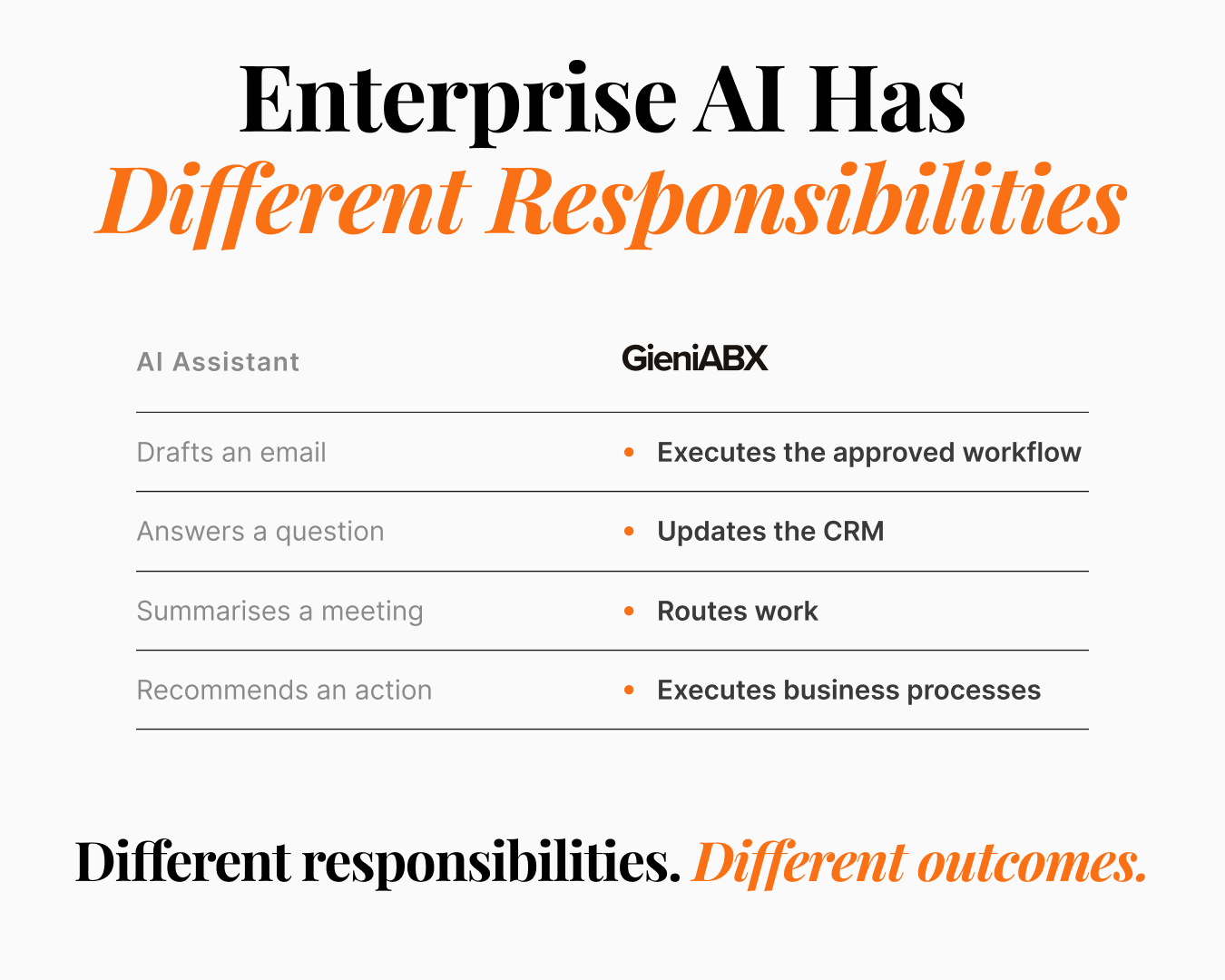
AI assistants exist to help people think, create and communicate better. They answer questions, produce content, analyse information and shrink the effort behind individual tasks, which is precisely why nearly every industry adopted them so quickly.
Business execution is a different responsibility altogether.
Execution means making sure approved work moves through the organisation exactly the way the business intends. After a decision is made, customer records need updating, opportunities have to progress through the CRM and tasks must be assigned according to the organisation's workflow. Every approved step has to carry on reliably across people, systems and departments so nothing grinds to a halt. Autonomous Business Execution was built for precisely this responsibility.
What this looks like in practice
Take a manufacturer that receives an enquiry from an existing customer asking to quote a repeat order.
An AI assistant can quickly pull up earlier conversations, surface the relevant product details and hand the account manager a concise summary. By the time the salesperson opens the opportunity, the context for a confident response is already there.
From here, the job shifts from making decisions to executing the approved workflow.
The opportunity lands in Salesforce, the approved workflow starts automatically and internal teams get the visibility they need. Follow-up activities are generated and every approved step runs automatically along the organisation's defined workflow. Routine execution moves ahead without manual coordination, while the salesperson stays in charge of the customer relationship and every business decision that calls for human judgement.
Within those approved business rules, the process keeps running on its own.
The difference matters: one technology raises the quality of decisions, the other raises the consistency of execution.
Both earn their place because they solve separate business problems.
Enterprise AI is specialising
As enterprise AI matures, organisations are finding that no single system can play every role.
The field is specialising. AI assistants lift day-to-day productivity, Agentic AI handles more demanding planning and reasoning, and Autonomous Business Execution takes on a responsibility of its own: executing approved business processes according to business rules so work carries on reliably across the organisation.
These technologies complement one another because each operates at a different point in the flow of work.
The future of enterprise software belongs to organisations that combine specialised technologies, each fulfilling its own responsibility. Some systems help people think, others support decision-making, and Autonomous Business Execution keeps approved work moving forward consistently across the organisation.
When those responsibilities are clearly understood, businesses spend less of their time coordinating work and more of it delivering results.