 Featured on

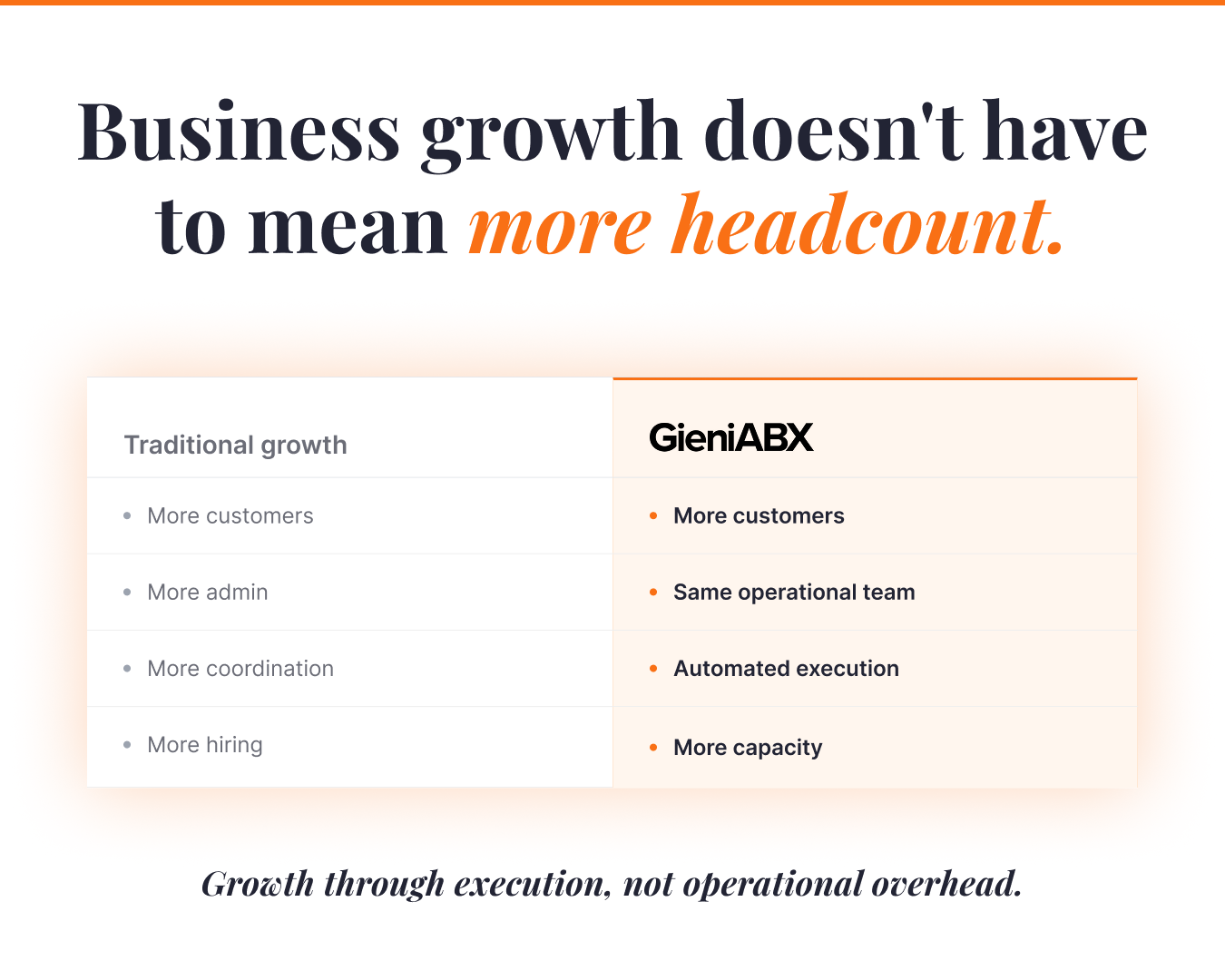
Growth is generally read as a marker of success. More customers, more opportunities and more projects all point to a business heading in the right direction. Inside the organisation, though, growth brings a quieter side effect. Each new customer produces follow-up activities, approvals and information that has to travel between people and systems. The larger the business becomes, the more operational work it takes just to keep everything in motion.
The hidden cost of growth: coordination work
This creeping rise in coordination rarely stands out at first. Over the course of an ordinary day, sales teams log customer updates after meetings, finance signs off purchase orders and project managers make sure the next team has what it needs to carry on. Each task looks routine on its own, yet combined they add up to a substantial coordination load that expands right alongside the business.
Why hiring has always been the default answer
Organisations have tended to answer this in the same way for years: as workloads climb, they hire. New coordinators come on board to manage projects, sales support grows to absorb operational tasks and administrative duties spread out across the business. The company keeps growing, and so does the effort needed to hold it all together.
For decades, this pattern defined how businesses scaled. Rising operational complexity was simply accepted as the price of success.
That assumption is now being questioned.
What AI changed — and what it didn't
Artificial intelligence has already reshaped how employees work. Information is easier to find, reports can be condensed in seconds and writing tasks that once ate half an hour now take minutes. All of that has made people more productive, but none of it has changed what happens once a decision is made. Customer records still need updating, approved workflows still have to keep moving and information still has to flow reliably between systems and departments.
That is the job of execution.
Execution is the missing layer
Autonomous Business Execution exists to execute approved business processes according to business rules the organisation has defined. Once a workflow is approved, the work carries on consistently, with no dependence on someone remembering the next step, checking whether an approval went through or shifting information between systems by hand. People stay responsible for the decisions that demand experience, judgement and context, while routine execution runs in the background.
The effect shows up most clearly when organisations grow.
How consistent execution absorbs the workload of growth
Picture a sales team that starts receiving twice the enquiries it handled a year earlier. Every opportunity runs through the same process: customer details are captured, ownership assigned, follow-ups scheduled and internal teams informed before anything moves forward. If nothing changes about how work travels through the business, every extra customer adds to the coordination burden that growth brings with it.
When approved business processes execute consistently, much of that extra workload gets absorbed without landing on people's desks. Employees spend less time updating systems, chasing approvals and coordinating routine activities, because those processes carry on according to predefined business rules. The freed-up time flows to where people add the most value: building customer relationships, working through complex problems and making sharper business decisions.
What capacity actually means
Creating capacity is often misread as pushing employees to work faster or squeezing more out of fewer resources. In reality, capacity comes from stripping away the operational work that keeps people from the responsibilities they were actually hired for. As routine execution grows more consistent, organisations become able to take on more business without operational overhead climbing in step.
Rethinking how businesses scale
For leaders mapping out the next phase of growth, this reframes the conversation. Scaling the business no longer rests solely on hiring more people to manage more coordination. Operations can scale because approved work continues reliably across the organisation, leaving existing teams free to concentrate where human judgement delivers the most.
As enterprise AI develops further, organisations will increasingly combine technologies that each carry a specific responsibility. Some sharpen the quality of information, others strengthen planning and decision-making, and Autonomous Business Execution keeps approved business processes running consistently across the organisation. Together they produce businesses that are more productive and, just as importantly, able to grow without letting operational complexity grow at the same rate.