 Featured on

Every organisation has its own way of working.
Sales opportunities progress through defined stages, approvals follow established policies and operational processes reflect the way the business has chosen to operate. These workflows have been developed over time to support customer relationships, internal governance and organisational objectives. They represent decisions made by people who understand the business, its priorities and the outcomes it wants to achieve.
The challenge is rarely deciding how work should happen.
Most organisations already have clearly defined processes. The difficulty lies in ensuring those processes continue consistently once decisions have been made. Routine execution often depends on employees updating systems, following up with colleagues, assigning tasks and confirming that work has progressed to the next stage. As operational complexity increases, maintaining consistency becomes more dependent on manual coordination than on the processes themselves.
Autonomous Business Execution begins with how the organisation already works.
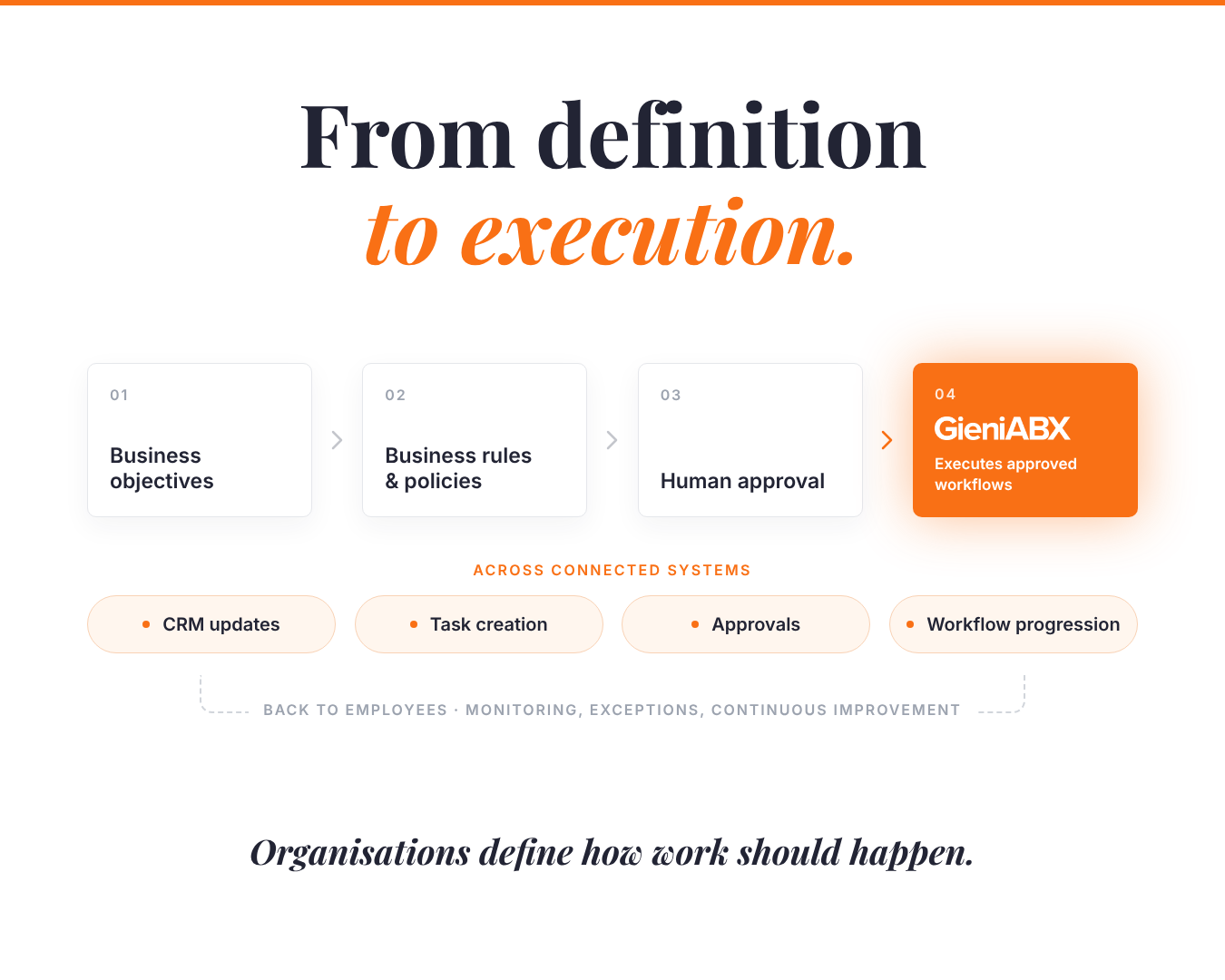
Before any execution takes place, business leaders define how work should progress. Approval requirements, operational policies, workflow logic and organisational responsibilities are established according to the company's own business objectives. These business rules create the framework that guides execution, ensuring every approved process reflects the way the organisation intends to operate.
Only after those rules have been defined does execution begin.
Autonomous Business Execution executes approved business processes according to the business rules established by the organisation. Customer records are updated, follow-up activities are created, operational tasks are assigned and approved workflows continue consistently across connected systems. Execution follows the operational framework created by people, allowing routine work to progress without requiring continuous manual coordination.
This distinction is fundamental to understanding Autonomous Business Execution.
Business strategy, process design and decisions about how the organisation should work remain the responsibility of the people who understand the business, its customers and its objectives. Autonomous Business Execution applies the operational framework they have already defined, ensuring approved work continues consistently while maintaining organisational control.
This approach also allows organisations to adapt as their business evolves.
Operational processes change over time as organisations introduce new services, refine customer journeys or improve internal workflows. Because execution is guided by business-defined rules, organisations can update those rules whenever requirements change. Autonomous Business Execution then applies the updated framework consistently across every approved workflow, allowing execution to evolve alongside the business without requiring employees to manually coordinate each operational step.
Defining business processes before execution creates consistency across the organisation.
Departments follow the same operational standards, approved work progresses according to established policies and employees retain confidence that execution reflects the organisation's intended way of working. Execution becomes predictable, repeatable and aligned with business objectives, reducing the reliance on individual follow-up or personal knowledge to keep work moving.
This principle forms the foundation of Autonomous Business Execution. Organisations define how work should happen. Autonomous Business Execution executes approved business processes according to those decisions. People remain responsible for strategy, governance and continuous improvement, while execution continues consistently across the business.