 Featured on

Organisations already know how work should happen. Sales opportunities follow established processes, customer requests move through defined workflows and approvals determine when the next stage of work can begin. Every business has operational rules that describe how work should progress, who is responsible for each step and what needs to happen before a process can continue.
The challenge is that carrying those processes forward often depends on manual coordination.
Employees update CRM records after customer meetings, notify colleagues when approvals have been completed and follow up on routine operational tasks to keep projects moving. Individually these activities appear straightforward, yet together they consume a significant amount of time across the organisation. As businesses grow, more customers, employees and systems naturally create more coordination, increasing the operational effort required simply to keep work moving consistently.
Autonomous Business Execution was designed to address that challenge by executing approved business processes according to business rules defined by the organisation.
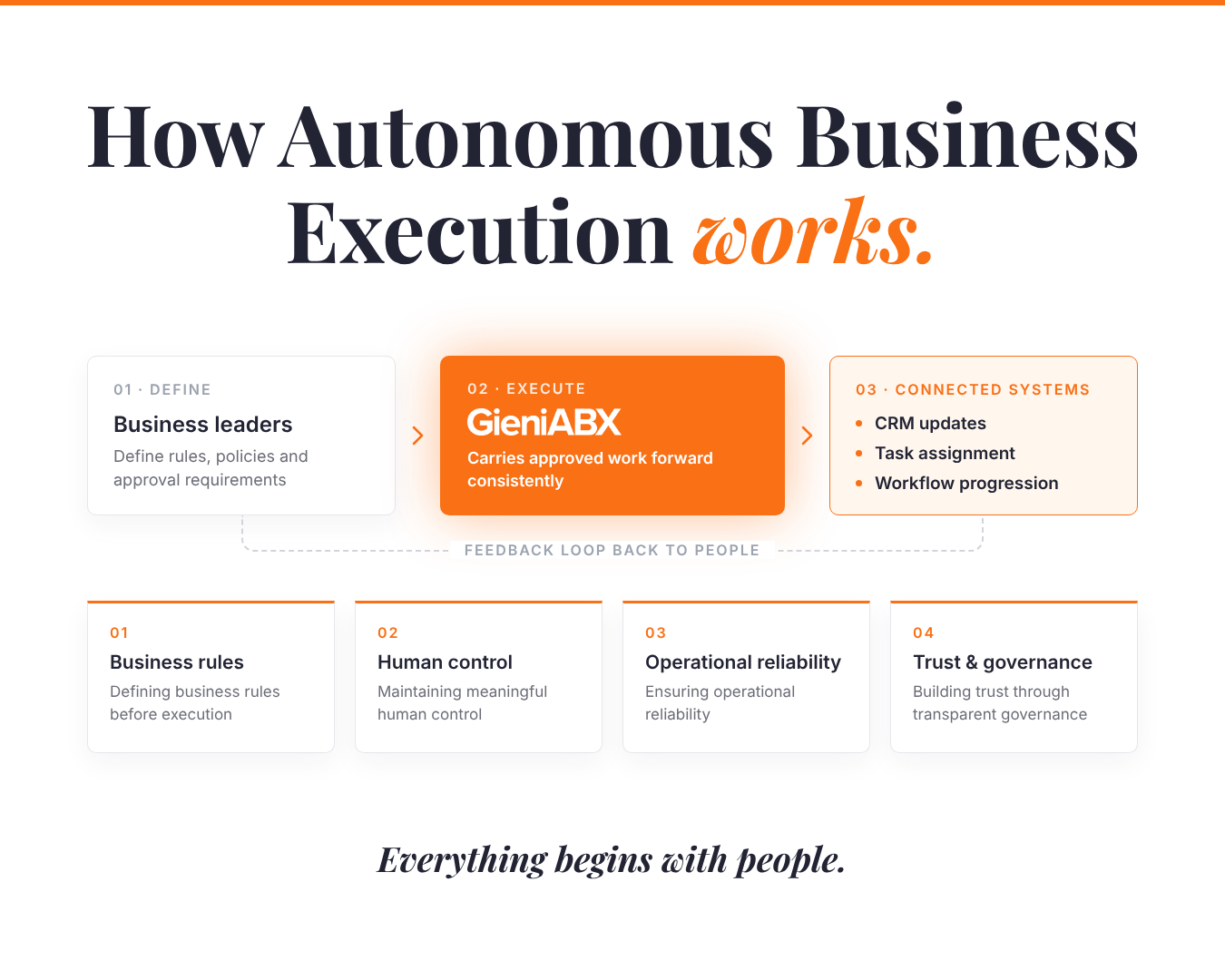
Everything begins with people.
Before any execution takes place, the organisation defines how work should progress. Business leaders establish operational policies, approval requirements and workflow rules that reflect how the company wants its processes to operate. These rules become the foundation for execution, keeping every workflow aligned with the organisation's intended way of working.
Once those rules have been established, Autonomous Business Execution carries approved work forward consistently across connected systems.
Customer records are updated, follow-up activities are created, operational tasks are assigned and approved workflows continue according to the business rules already defined by the organisation. Routine execution becomes consistent across departments while employees remain responsible for strategic decisions, process improvements and situations that require human judgement.
Human oversight remains an essential part of the process.
Employees continue deciding how work should be performed, approving important actions and reviewing exceptions when circumstances fall outside established business rules. Autonomous Business Execution operates within the operational framework created and maintained by the organisation, keeping execution aligned with business objectives and human control firmly in place.
Consistency is equally important.
Business processes often span multiple departments, systems and teams. A single customer request may involve sales, finance, operations and customer support before reaching completion. Maintaining reliable execution across those handovers becomes increasingly challenging as organisations scale. Autonomous Business Execution applies the same business rules throughout every approved workflow, so that organisations execute processes consistently regardless of where work moves within the business.
Trust is built through transparency and governance.
Organisations need confidence that business processes execute according to clearly defined policies and that employees remain able to oversee, adjust and improve those processes over time. Business rules remain visible, operational decisions remain under human control and execution continues within organisational boundaries established before work begins.
Together, these principles form the foundation of Autonomous Business Execution. Organisations define how work should happen, people remain responsible for decisions and governance, while Autonomous Business Execution executes approved business processes consistently across connected systems. The result is less manual coordination, greater operational consistency and more capacity for employees to focus on the work that creates the greatest value for the business.
The following principles each play an important role in making this possible. Defining business rules before execution, maintaining meaningful human control, ensuring operational reliability and building trust through transparent governance all contribute to execution that organisations can rely on as they scale.