 Featured on
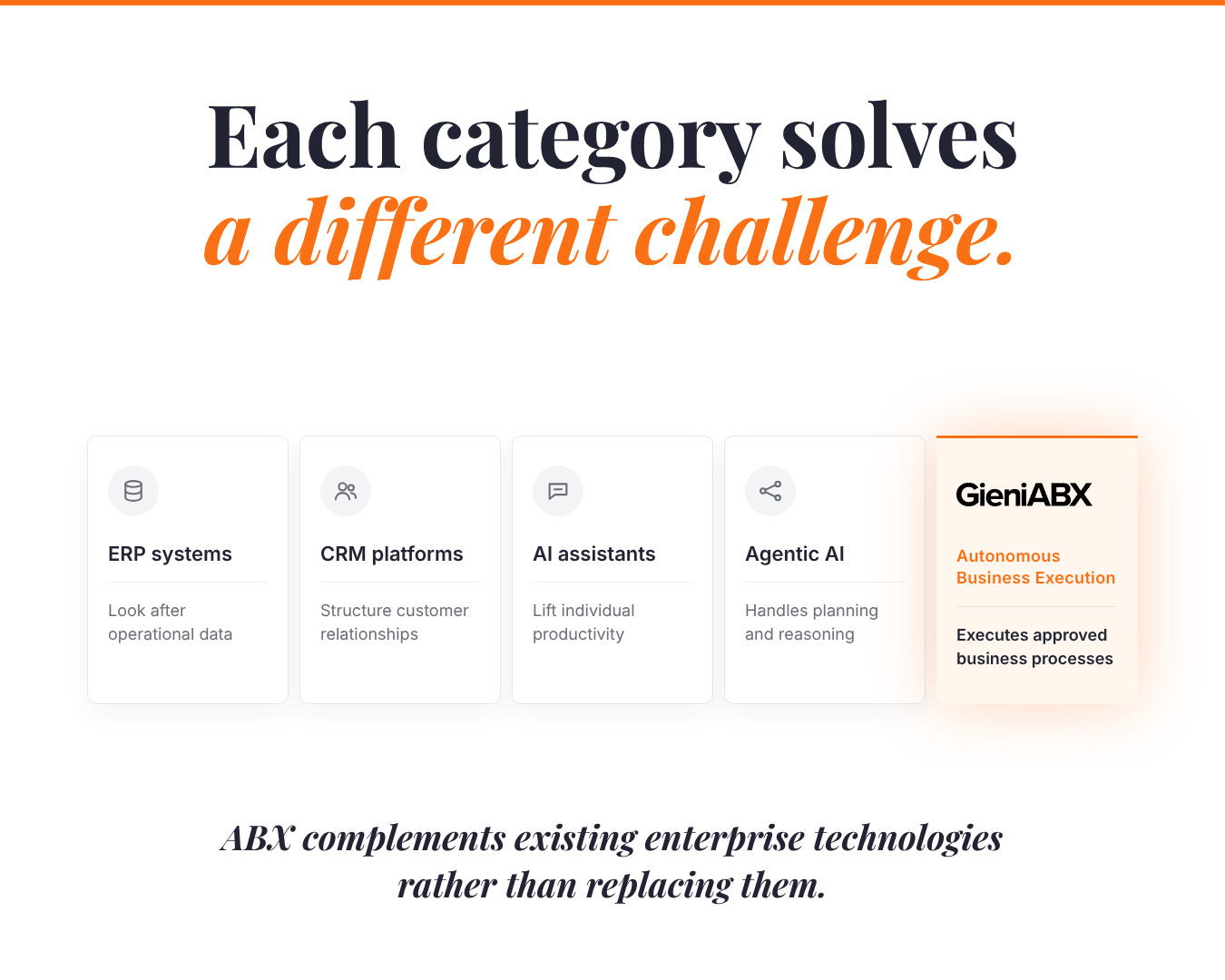
Enterprise software has grown into a set of specialised categories, each carrying its own responsibility. ERP systems look after operational data, CRM platforms structure customer relationships, AI assistants lift individual productivity, Agentic AI handles planning and reasoning, and Autonomous Business Execution executes approved business processes consistently across the organisation.
Each of these technologies keeps its place in the modern organisation because each solves a different operational problem. Combined, they have made businesses better informed, better connected and more productive than at any point before.
The execution gap enterprise software hasn't closed
And yet one challenge has barely moved.
Every organisation lives or dies by work passing reliably from one stage to the next. Customer enquiries need follow-up, sales opportunities pass through layers of approval, projects depend on clean handovers and operational processes cut across departments and systems. Enterprise software gives organisations visibility into all of this activity, but a large share of the actual execution still depends on people pushing work forward by hand.
Growth makes that harder to sustain. More customers, employees and systems mean more processes to coordinate, and more operational effort just to keep the business running. Teams sink real time into chasing approvals, updating records, assigning tasks and getting information to the right people at the right moment. As enterprise AI matures, organisations are starting to weigh execution as heavily as intelligence.
What is Gen 3 Execution Software?
A new category of enterprise software is taking shape around exactly this gap.
Gen 3 Execution Software exists to execute approved business processes according to business rules the organisation defines, going beyond delivering information to actually carrying work forward. Routine execution turns consistent, repeatable and scalable, while employees keep ownership of the judgement, experience and business context that call for human oversight.
How Autonomous Business Execution runs approved processes
The capability behind this category is Autonomous Business Execution.
Once the organisation has settled how work should progress, Autonomous Business Execution runs those approved processes consistently across connected systems. Sales opportunities move through the CRM, customer records stay current, operational tasks land with the right owners under the defined business rules and approved workflows keep going without manual coordination holding them up. Employees carry on making decisions, resolving exceptions and deepening customer relationships while routine execution runs reliably behind the scenes.
What changes with Gen 3 Execution Software
This shifts how organisations think about enterprise software altogether.
Earlier generations concentrated on organising information, improving visibility and raising productivity. Gen 3 Execution Software makes execution its core responsibility. Organisations gain the ability to execute approved business processes consistently and at scale, with human control preserved over every decision that needs expertise and judgement, and without leaning on employees to coordinate routine operational work day after day.
Where enterprise software goes next will depend on how well organisations combine specialised categories, each with its own operational role. ERP systems will keep managing operational data, CRM platforms will keep structuring customer relationships, AI assistants will keep raising individual productivity and Agentic AI will keep supporting planning and reasoning, while Autonomous Business Execution makes sure approved business processes carry on consistently across the organisation.
Every category strengthens business performance in its own way, because every category was built against a different challenge, position to scale operations, hold their consistency and execute with real reliability. Competitive advantage will increasingly flow from converting approved decisions into completed work, placing execution alongside information, productivity and planning as a core pillar of modern enterprise technology.