Featured on Microsoft News →

    Back to blog

    EXECUTION ERA

    The Agentic Enterprise Is Here. Your CRM Is the Foundation.

    What Agentforce World Tour Zurich revealed about the future of CRM execution — and why the gap between "request" and "deployed" is about to disappear.

    Samuel Bucher

    Samuel Bucher

    Marketing Manager, Gieni ABX

    Published 7 min read
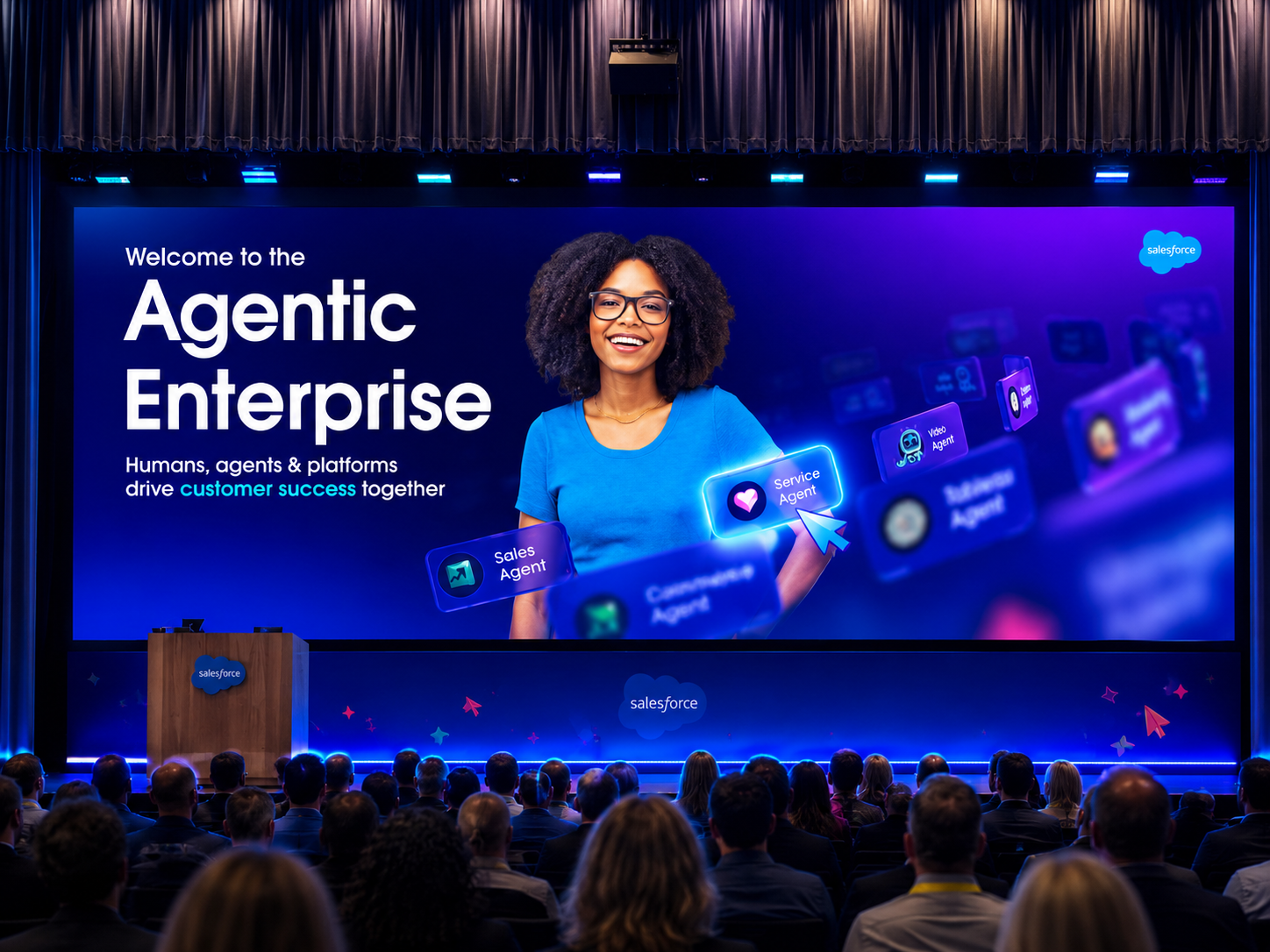
    Welcome to the Agentic Enterprise — Agentforce World Tour Zurich keynote stage
    Agentforce World Tour Zurich.

    A packed auditorium in Zurich. On screen, a slide that would have been unthinkable two years ago: "Welcome to the Agentic Enterprise." No qualifiers, no "vision for 2028." A statement of fact. Salesforce wasn't pitching a future on June 16. They were describing what's already running.

    We were in the room. The architecture presented on stage that day describes what Gieni ABX for Salesforce already executes as an independent execution layer, connected to the customer's own Salesforce org.

    But between the keynotes and the demos, one insight cut through everything else. It finally said out loud what every Salesforce admin already knows:

    CRM has historically been painful and time-consuming. Low adoption is an execution problem.

    The room went quiet for a second. Everyone recognized it.

    Human intent, agent execution

    The opening keynote introduced the concept of the agentic enterprise: humans set intent and judgment, agents handle execution. AI takes operational responsibilities and gives back time. The framing was deliberate: eliminate the gap between what someone decides and when that decision becomes reality inside a system.

    For anyone managing a Salesforce org, this gap is painfully familiar. Salespeople don't hate selling. They hate updating Salesforce. Admins don't hate their jobs. They hate the endless queue of field changes, validation rules, and Pricebook updates that leaves zero time for the work that actually matters.

    Each request is straightforward. The queue, however, never ends.

    The Agentforce vision says: that queue should execute itself.

    Headless 360 — software built for agents

    One of the most forward-looking ideas at the event was Salesforce's "Headless 360" vision: decoupling CRM from its user interface entirely and building software for agents to use, not for humans.

    The shift is fundamental: from how do I get the data to how do I make the agent act on the data. Agents access Salesforce via API, not through a logged-in session. They don't click buttons. They read the schema, understand the context, and execute programmatically.

    That's how ABX for Salesforce already works. ABX connects to the customer's Salesforce org, authenticates with their OAuth credentials, reads the metadata structure, and executes changes directly: fields, validation rules, flows, Pricebook entries. No human session. No manual configuration. The customer defines what needs to happen in plain language. ABX maps it to objects and executes.

    The Headless 360 vision confirms the direction: the future of CRM operations is not a better admin interface. It's no interface at all.

    The data quality equation

    Another recurring theme across the event: agents are only as good as the data they act on. Improve data quality, and people use the CRM more. People use it more, and agents perform better. It's a compounding loop.

    This is why ABX connects to sandboxes for configuration work and to production for data operations:

    • Metadata changes — fields, validation rules, page layouts — are built and tested in your sandbox, then deployed via standard Salesforce change sets.
    • Data operations — record updates, deduplication, enrichment — execute directly on production with a full audit trail.

    Execution quality matters as much as execution speed. Every change ABX makes is logged, traceable, and reversible. The admin keeps full control and loses the backlog. That backlog extends well beyond admin work. It shows up everywhere a human touches the CRM.

    Based on our own sales team's workflow: after every discovery call, a rep typically spends 20 to 25 minutes on post-call administration. Structuring notes, updating CRM fields, writing a personalized follow-up, setting the next task. Multiply that across ten calls a day, and roughly three and a half hours disappear before anyone picks up the phone again.

    With ABX, the same process executes end-to-end: notes structured, fields updated, follow-up drafted in the rep's tone, task created with context. The rep reviews and approves in under three minutes. See how ABX executes Salesforce changes sandbox-first.

    2,000+ hours of execution capacity recovered per year

    For a team of three SDRs, that's the estimated capacity recovered when post-call administration runs end-to-end instead of by hand.

    At the leadership layer, the pattern scales. A sales director managing fifteen reps estimates 14 to 20 hours every week on data collection, pipeline analysis, review preparation, and CRO reporting. With ABX, the same outputs generate automatically and land for approval Thursday evening. The director reviews in thirty minutes Friday morning. By our internal estimates, that redirects roughly 800 hours per year from data collection to the decisions that actually move revenue.

    Trust isn't a feature — it's the reason Switzerland matters

    If there was one topic where the Zurich audience leaned in more than any other, it was trust. Multiple sessions addressed Swiss data residency through Hyperforce Switzerland, fully compliant with the Swiss Data Protection Act (nDSG). For every Swiss company in the room evaluating agentic technology, this was the moment that turned theoretical interest into practical possibility.

    The message was unambiguous: explainability, auditability, and human-in-the-loop controls are baseline requirements for any enterprise deployment.

    ABX was built on this same conviction. Every execution follows a strict four-step loop:

    Define → Plan → Approve → Execute

    Nothing writes to the customer's org without explicit approval. OAuth authentication is per user. The full audit trail documents what changed, when, and why. For companies operating under Swiss regulatory standards, this level of governance is what makes autonomous execution viable in the first place.

    The window is closing

    The closing argument of the event was clear: companies that move to hybrid operating models, where human-led, agent-led, and collaborative processes run in parallel, gain compounding advantages. Every AI improvement builds on the last, widening the gap over time. This is what leading companies are deploying right now.

    The gap between "request" and "deployed" is where the hours go. Not on strategy. Not on architecture. On routine configuration. The companies that close this gap first build execution capacity that compounds without adding headcount.

    That's the shift the Agentforce World Tour made tangible. Not a roadmap, but an operating reality for every company willing to move now.

    Stop managing work. Start completing it.

    Gieni ABX for Salesforce executes admin work directly inside your org. Connect to your sandbox for configuration. Connect to production for data operations. It writes. Everything else just reads.

    See how ABX executes Salesforce changes autonomously